News & Notices



Nonlinear optical (NLO) crystals, known for their unique frequency conversion capabilities, are critical optical materials for obtaining ultraviolet (UV) and deep-ultraviolet (DUV) laser sources. They hold significant practical importance in modern high-tech fields such as national defense, semiconductor lithography, photonic communications, precision medicine, and additive manufacturing. Currently commercialized representative UV NLO crystals include β-BaB2O4 (BBO), LiB3O5 (LBO), and BaMgF4. However, high-performance DUV NLO crystals remain scarce. Due to the interdependent requirements of the three key optical properties of crystal materials, namely UV absorption cutoff edge, frequency doubling response, and birefringence, on the microstructure of crystals, designing and preparing nonlinear optical crystals that can achieve efficient UV and even DUV light output is an important scientific challenge and enormous challenge faced by researchers in related fields.
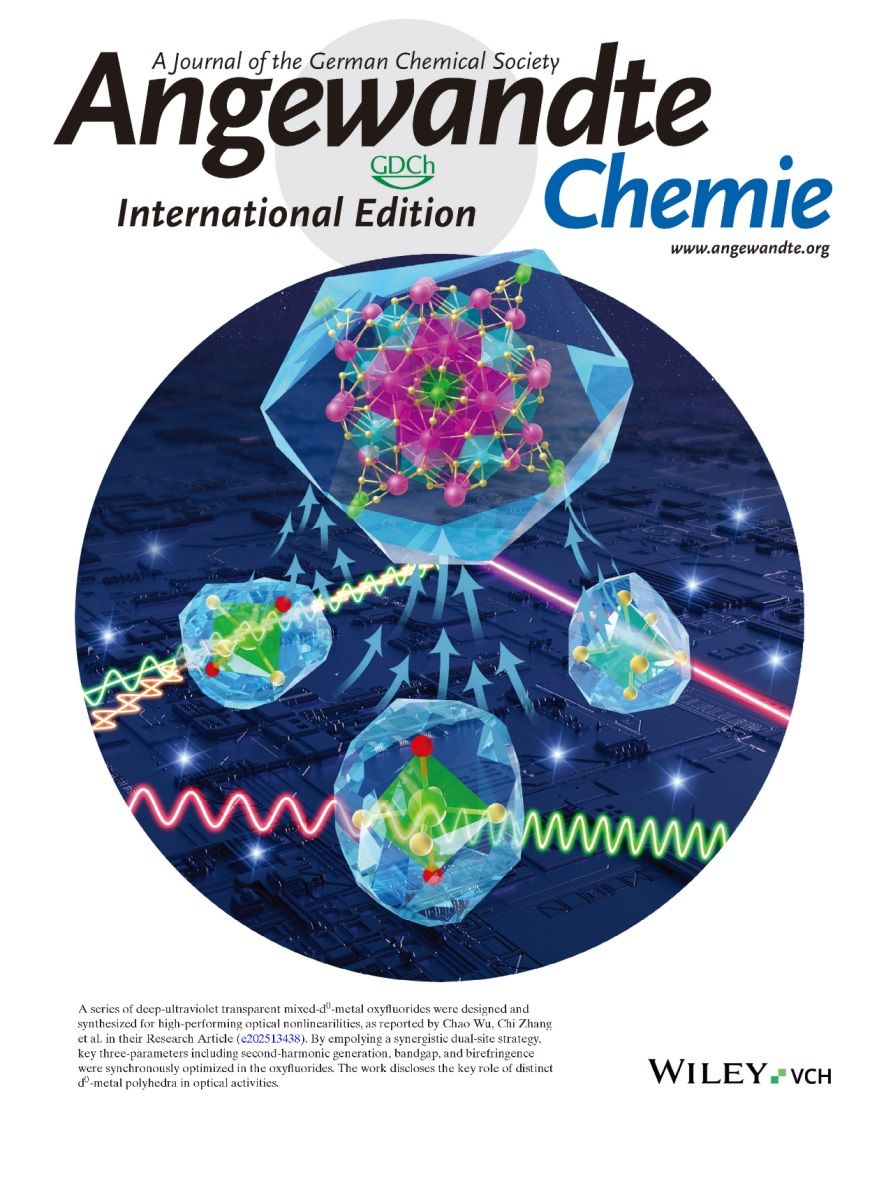
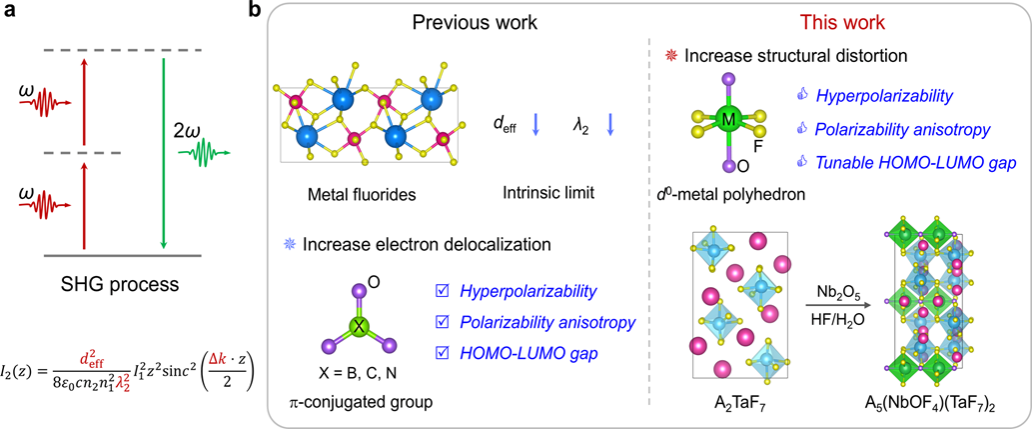
Recently, the research team led by Professor Zhang Chi, a member of the European Academy of Sciences, the German National Academy of Engineering, and the School of Chemical Science and Engineering at Tongji University, has made significant progress in the study of mixed d0 transition metal second-order nonlinear optical crystal materials, achieving a new breakthrough in the trade-off between deep ultraviolet transparency and nonlinear optical performance of second-order nonlinear optical crystal materials. The research team from the School of Chemical Science and Engineering at Tongji University, in close collaboration with the Beijing Institute of Physical and Chemical Technology of the Chinese Academy of Sciences and the Australian National University, used first principles calculations to screen transition metal fluorine-containing elements. By adopting a synergistic dual site strategy, they synthesized the first deep ultraviolet transparent and 266 nm harmonic generation hybrid d0 transition metal material A5(NbOF4)(TaF7)2 (A=K, Rb, Cs, NH4), and explored and elucidated the regulatory mechanism of controlled fluorine-containing elements on the optical properties of crystal materials. The related research results, titled "Breaking the Deep UV Transparency/Optical Nonlinear Trade Off: Three Parameter Optimization in Oxyfluorides by Tailoring d0 Metal Incorporations", were recently published in full text (Research Article) in the top international academic journal of chemistry and materials, Angewandte Chemie International Edition, and were selected and recommended by the editorial committee as the cover article (Inside Front Cover) and hot paper (HOT Paper) of the current issue.
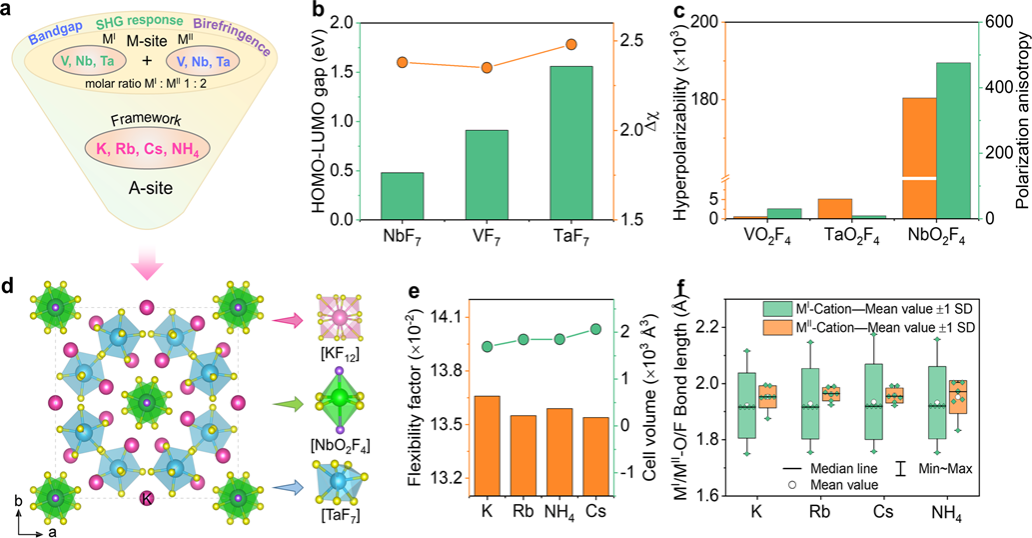
In this study, the research team systematically analyzed and screened a series of fluorinated d0 transition metal elements based on first principles calculations, and adopted a two-step synthesis method that is different from the traditional one-step synthesis method. Firstly, the precursor of d0 transition metal fluoride A2[TaF7] was synthesized, and then further reacted with another d0 transition metal oxide Nb2O5 to successfully synthesize the optimal element combination A5(NbOF4)(TaF7)2, achieving synergistic enhancement of niobium tantalum oxyfluoride crystal materials in three key optical properties. Among them, the partially fluorinated [NbO2F4] element exhibits high micro polarization and significant polarization anisotropy, while the fully fluorinated [TaF7] element shows a larger HOMO-LUMO bandgap. The [NbO2F4] octahedron, as a nonlinear optical functional element, is connected through angle sharing to form a one-dimensional chain structure, thereby achieving effective superposition of microscopic polarizability; The fully fluorinated [TaF7] element is assembled with A-site cations to form a three-dimensional framework structure, and its high transparency in the ultraviolet band ensures the wide bandgap advantage of the system. In order to further investigate the influence of F/O coordination regulation on the optical properties of [NbO2F4] and [TaF7] elements at the atomic scale, the research team conducted density of states calculations and crystal orbital Hamiltonian population (COHP) analysis. The analysis and calculation results of crystal orbitals indicate that the participation of F 2p orbitals weakens the (d-p) π conjugation between metal d orbitals (dxz, dyz, dxy) and ligand p orbitals, increases the energy of π orbitals, and reduces the π* energy level. This electronic structural change effectively reduces the electron density of the anti-bonding HOMO energy level, improves the optoelectronic properties of the material, and for the first time reveals a new mechanism for designing deep ultraviolet nonlinear optical materials.
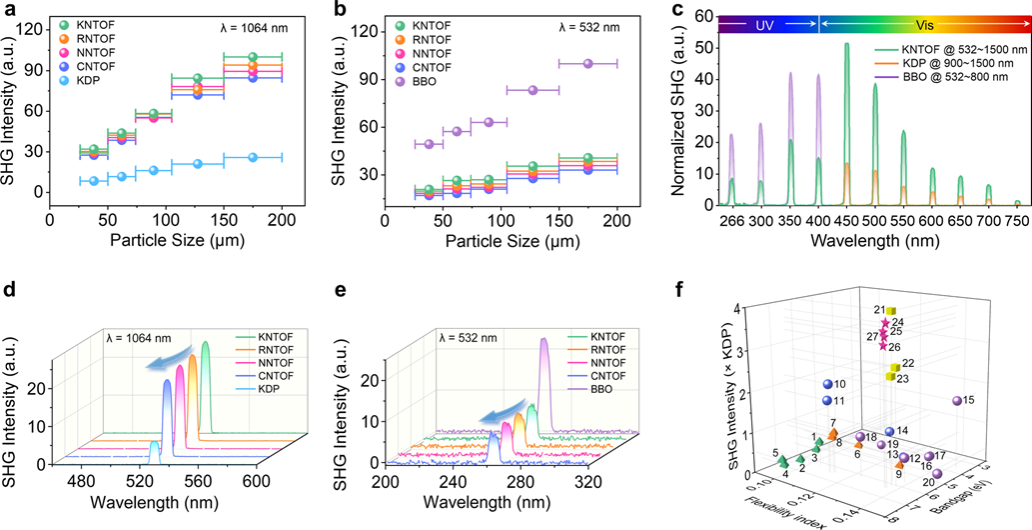
The research team also used single crystal X-ray diffraction analysis to analyze the crystal structure of A5(NbOF4)(TaF7)2. The structure is mainly composed of polar [NbO2F4] one-dimensional chains and [TaF7] three-dimensional framework structures. The A-site cations (A=K, Rb, Cs, NH4) connect the two different functional elements through ionic or hydrogen bonds. The [NbO2F4] octahedral one-dimensional chains are interspersed in the cavities of the [TaF7] three-dimensional framework structure. The research team further applied first principles calculations and theoretically confirmed the optical synergistic effect between two different d0 transition metal structural units by analyzing the frequency doubling weighted density and real space atomic cutting techniques. The experimental results show that A5(NbOF4)(TaF7)2 exhibits significant powder frequency doubling effects in both the ultraviolet and visible spectral ranges (0.33−0.38 × β-BaB2O4 @ 532 nm, 3.3−3.8 × KH2PO4 @ 1064 nm), while also possessing moderate birefringence (Δ n=0.093−0.105 @ 546 nm) and a short ultraviolet absorption cutoff edge (195 nm). This study achieved for the first time the output of 266 nm fourth harmonic ultraviolet light in d0 transition metal crystal materials, which has important scientific significance and demonstration value for the development of new high-performance ultraviolet second-order nonlinear optical crystal materials.
Academician Zhang Chi is the corresponding author of the paper, Professor Wu Chao is the co-corresponding author of the paper, PhD students Zhang Xiaotian and Assistant Professor Duanmu Kaining from the School of Chemical Science and Engineering are the co-first authors of the paper, and Professor Huang Zhipeng participated in the relevant research work. This research work has received support from key and general projects of the National Natural Science Foundation of China, innovation teams of the Ministry of Education, innovation teams of key fields of the Ministry of Science and Technology, discipline innovation plans of higher education institutions under the Ministry of Education State Administration for Foreign Experts Affairs, and key projects of the Shanghai Municipal Education Commission's Science and Technology Innovation Plan.
Article link: https://onlinelibrary.wiley.com/doi/10.1002/anie.202513438
Cover link: https://onlinelibrary.wiley.com/doi/10.1002/anie.202521815


Copyright © 2025 School of Chemical Science and Engineering, Tongji University