Research



Nonlinear optical (NLO) crystals, as the core materials for laser frequency conversion, are key to obtaining deep-ultraviolet (DUV) laser light sources. They are widely used in high-tech fields such as semiconductor lithography, precision medical treatment, ultrafast spectroscopy, and remote sensing detection. However, currently commercialized DUV NLO crystals generally face performance bottlenecks, especially the inherent trade-off between second-harmonic generation (SHG) efficiency and a wide bandgap, which restricts further performance improvement. Therefore, developing new crystalline materials that combine strong NLO response with high DUV transparency has become an urgent need in this field.
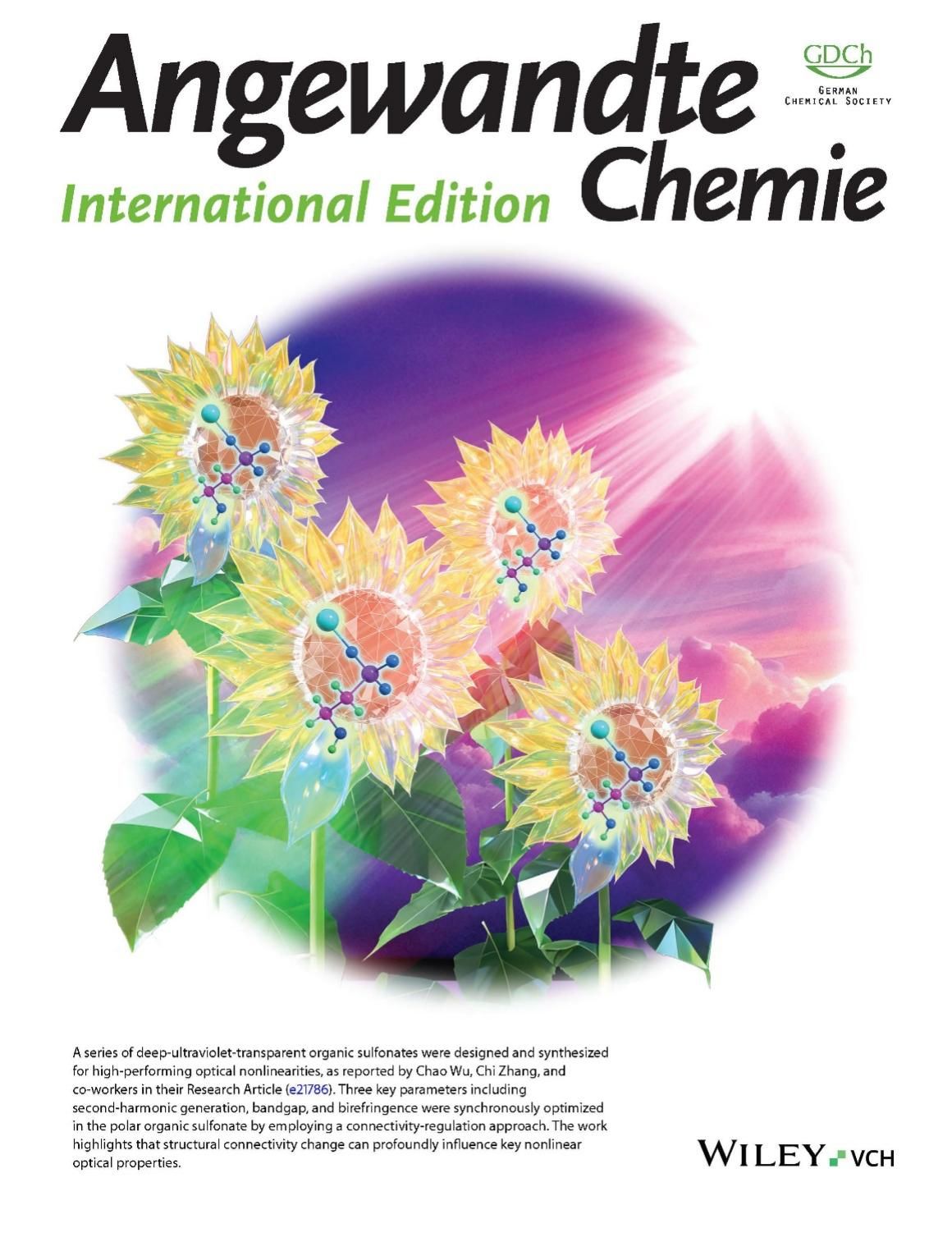
Recently, the research team of Professor Zhang Chi, a European Academy of Sciences Academician, German National Academy of Science and Engineering Academician, from the College of Chemical Science and Engineering at Tongji University, in collaboration with the Beijing Institute of Technology, Chinese Academy of Sciences, the Australian National University, and other institutions, has made significant progress in the research of DUV-transparent polar organic sulfonate NLO crystals. The research team proposed a "connectivity-regulation" strategy. By precisely tuning the anionic alkyl chains or counter cations, they successfully synthesized a series of high-performance organic sulfonate crystals. Among them, the Li[SO3(CH2)2OH] crystal successfully achieved the synergistic optimization of DUV transparency and NLO performance. The related achievement, titled "Unlocking Strong Second-Harmonic Generation in Deep-UV-Transparent Polar Organic Sulfonates through Connectivity Regulation," was recently published in full as a Research Article in the authoritative international chemistry and materials journal Angewandte Chemie International Edition (2025, e21786). It was selected and recommended by the editorial board as the cover article and a Hot Paper for that issue.
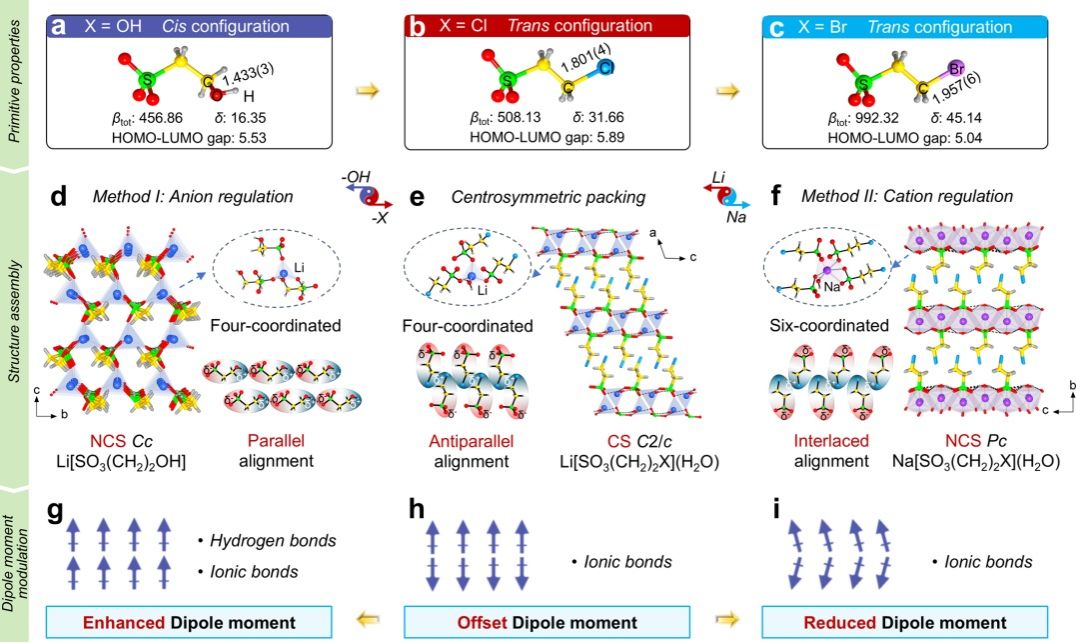
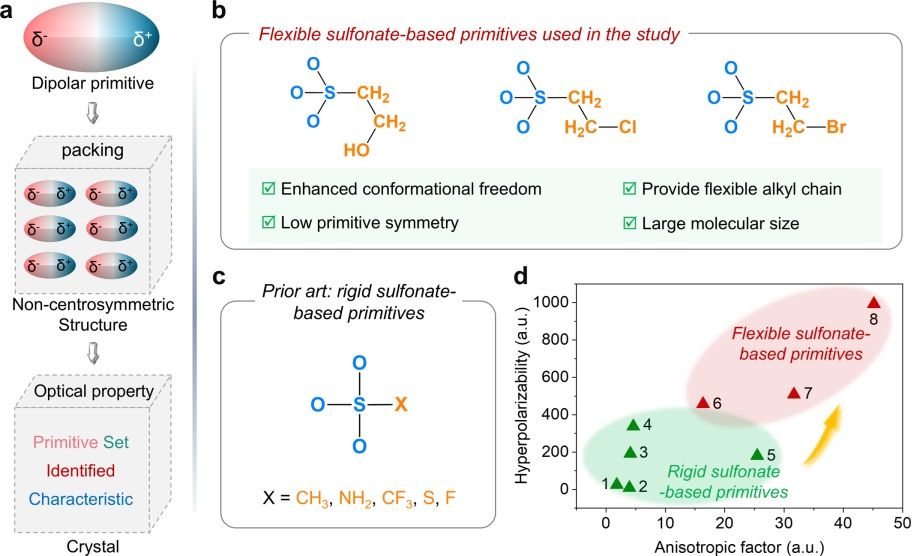
In this research, addressing the challenge that traditional organic sulfonate crystals struggle to balance a wide bandgap with a strong SHG response, the team innovatively employed flexible sulfonate building blocks [SO3(CH2)2X]- (X = OH, Cl, Br) and achieved precise structural and performance optimization through two pathways: first, by replacing counter cations (Li+, Na+) to alter the crystal coordination environment and molecular packing; second, by modifying the terminal substituents of the anionic alkyl tails to regulate intermolecular hydrogen bonding and dipole moment alignment. Based on this design strategy, the team successfully prepared a series of materials: the parent compounds Li[SO3(CH2)2X] (X = Cl, Br), the polar compounds Na[SO3(CH2)2X] (X = Cl, Br), and the best-performing Li[SO3(CH2)2OH]. The study found that in the Li[SO3(CH2)2OH] crystal, the [SO3(CH2)2OH]⁻ anions form a parallel alignment through the synergistic effect of hydrogen bonds and ionic bonds, effectively avoiding the cancellation of dipole moments. In contrast, the comparative crystals Li[SO3(CH2)2X] and Na[SO3(CH2)2X] exhibit antiparallel and staggered antiparallel arrangements, respectively. This structural difference dominated by connectivity regulation directly leads to significant differentiation in the macroscopic optical properties of the crystals.
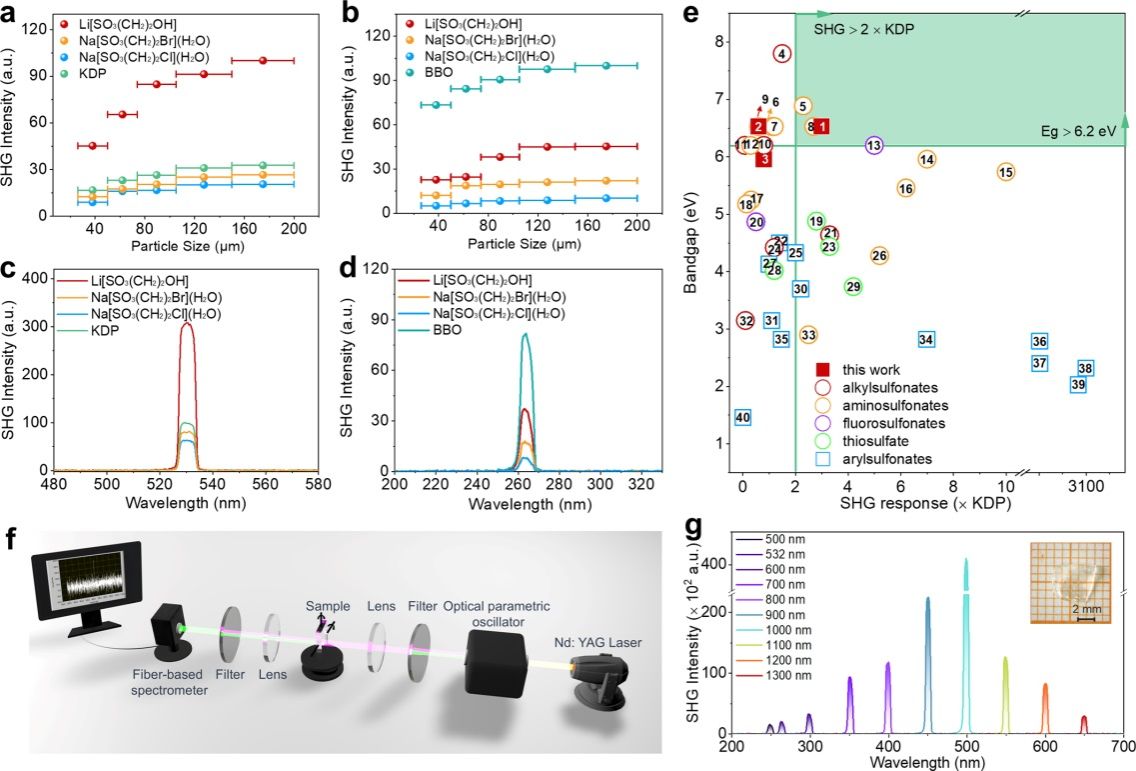
The Li[SO3(CH2)2OH] crystal demonstrates outstanding comprehensive optical properties: a strong powder SHG effect (3.0 × KDP @ 1064 nm, the highest value among DUV-transparent sulfonates), a significant bandgap (> 6.53 eV), and a moderate birefringence (Δn(001) = 0.06 @ 546 nm). This stands in sharp contrast to the weak powder SHG effect (0.6−0.8 × KDP @ 1064 nm) of the analog Na[SO3(CH2)2X]. The phase-matching ability of Li[SO3(CH2)2OH] and Na[SO3(CH2)2X] can extend into the solar-blind ultraviolet region (e.g., achieving SHG at 532 nm), providing potential for fourth-harmonic generation based on Nd:YAG lasers. The team further used theoretical methods such as first-principles calculations and crystal orbital Hamilton population (pCOHP) analysis to reveal the intrinsic mechanism of performance optimization: the high hyperpolarizability and polarizability anisotropy of the flexible sulfonate building blocks lay the foundation for the strong SHG response, while the parallel anion configuration guided by the synergistic hydrogen and ionic bonds achieves additive enhancement of the microscopic polarizability. This research clarifies the dominant role of connectivity regulation on the NLO properties of organic sulfonates, providing a new paradigm for breaking the performance trade-off in DUV materials.
This research received support from projects including the National Natural Science Foundation of China General Program and Joint Fund Key Program, the Ministry of Education Yangtze River Innovation Research Team, and the Australian Research Council. Academician Zhang Chi is the corresponding author of the paper, Professor Wu Chao is a co-corresponding author, Doctoral student Gong Feiyuan and Assistant Professor Duanmu Kaining from the College of Chemical Science and Engineering at Tongji University are co-first authors, and Professor Huang Zhipeng participated in the related research work.
Article link: https://onlinelibrary.wiley.com/doi/10.1002/anie.202521786
Cover link: https://onlinelibrary.wiley.com/doi/10.1002/anie.2025-m2112094200


Copyright © 2025 School of Chemical Science and Engineering, Tongji University